About Me

- Pamela Clare
- I grew up in Colorado at the foot of the Rocky Mountains, then lived in Denmark and traveled throughout Europe before coming back to Colorado. I have two adult sons, whom I cherish. I started my writing career as a columnist and investigative reporter and eventually became the first woman editor of two different papers. Along the way, my team and I won numerous state and several national awards, including the National Journalism Award for Public Service. In 2011, I was awarded the Keeper of the Flame Lifetime Achievement Award for Journalism. Now I write historical romance and contemporary romantic suspense.
Seductive Musings

Subscribe To


 Posts
All Comments
Posts
All Comments
BARELY BREATHING is FREE today!
BARELY BREATHING is FREE today!

Dear Friends,
It’s been a long time since you’ve heard from me. I’m grateful for the support you’ve shown me during these past three years, as I’ve struggled with the aftereffects of cancer treatment. As a thank you and to celebrate better days ahead, I’ve offering Barely Breathing, the first book in the 10-book Colorado High Country series, for FREE for a limited time, on Kindle, Nook, iBooks, and Kobo. The book is also available for download on Books2Read.
The Colorado High Country series follows the adrenaline-soaked adventures of the men and women on the Rocky Mountain Search and Rescue Team. I grew up rock climbing, hiking, rafting, and camping in the Rockies and have firsthand experience of being rescued after a near-fatal 40-foot fall off Mt. Ida in Rocky Mountain National Park. Write what you know, right?
Here's a glimpse of Lexi and Austin’s story…
A hot contemporary romance from the author of the acclaimed I-Team series…
Lexi Jewell left Scarlet Springs twelve years ago, vowing never to return to the small Colorado mountain town where she grew up. Now, here she is—over thirty, out of a job and with little choice but to move back in with her eccentric father. Lexi knows it’s just a matter of time before she runs into Austin Taylor, her first boyfriend and her first heartbreak. She’s determined to show him she’s over him—until he steps out of a pickup truck and back into her life, looking sexy as hell in his mountain ranger uniform.
As far as Austin is concerned, Lexi can turn her snazzy little convertible around and drive back to Chicago. After all, she ripped his teenage heart to pieces and turned her back on the town he loves. But from the moment he sees her again, he can’t get her out of his mind. Even her smile messes with his head.
When an evening of conversation turns into something else, Lexi and Austin agree to be friends—with benefits. But as Lexi starts making plans to return to the big city, Austin realizes he’ll lose her a second time unless he can show her that what she’s searching for has been right here all along.
As those of you who’ve followed my journey know, it’s been a crazy ride. It started in spring of 2022, when I learned the bone in my upper jaw was dissolving as a result of radiation treatment. I needed two bone grafts to address that. That was fun.
Then in July 2022, I began having terrible pelvic pain. I spent two years being misdiagnosed before I finally learned in 2024 that I have Interstitial Cystitis. IC is a rare autoimmune disease that causes terrible bladder pain. My doc thinks it was triggered by chemo. I’ve been getting regular treatments since May 2024, and I’m finally close to remission. I cannot tell you how wonderful it is to feel pieces of my life come together again after so many long, dark months.
And so I am celebrating with a free book and lots of spring flowers in my garden. I hope to be writing regularly soon. Fingers crossed!
Thanks again for your support! You have no idea how much it has meant to me these past three years.

COVER REVEAL! Plus the kindness of friends.

Here it is—the cover for Snow and Starlight (Wildest Alaska, #2), CGIS Special Agent Chase Santee and Anya Alexyev's story. For health reasons, I’ve only written three chapters so far. But already, these two are striking sparks off one another.
What can I tell you about the story?
For starters, the book opens with Anya’s first day at her first real job. She’s just joined the staff of the Kodiak Courant as a reporter, leading her headlong into a conflict with Chase.
The two of them are so much fun together.
Watch for an excerpt soon!
***

Writing is my profession. But prolonged health struggles have kept me from writing since I finished Fire and Rain (Wildest Alaska #1). In fact, the last third of that book was written when I was in hellish pain. Not one to miss a deadline, I forced words out of myself with tears running down my face day after day until it was finished because I felt so awful.
I shared with you last month how I passed out, hit my head, and got a concussion. No one was able to say why I passed out, despite many scans and tests. But the cause was likely a series of UTIs and related infections that I've been battling again and again since July.
I've seen specialists and had every test imaginable since July, and it seems that chemotherapy for breast cancer in 2014 has caused long-term damage to the organs in my pelvis. That damage has left me vulnerable to infection and something worse—constant nerve pain in my bladder and all of my female tissues.
I haven’t shared this until recently because it’s rather personal. It seems that treatment for estrogen-positive breast cancer can damage cells in the body that have estrogen receptors—which includes every tissue in a woman’s pelvis.
What this has meant for me is an inability to write or really function because I'm grappling with pain that prevents me from sleeping. My sister was here in September because she'd come to help me navigate doctor visits and the emotional struggles of constant misery.
The medical bills have been horrendous, and my not being able to write due to exhaustion and pain is going to have a long-term impact. I do have a new treatment plan, but it's a long-term plan, with recovery expected in roughly six months.
One day a couple of weeks ago, author Toni Anderson got in touch with me about an unrelated topic, and I fell completely apart. I told her everything. The next day, author Katie Reus contacted me to tell me that she, Toni, and Kaylea Cross had put together a Go Fund Me campaign to help me cover medical bills and lost work time.
As hard as it is for me to ask for or to accept help, I’m deeply grateful to Kaylea, Katie, and Toni and to all of my friends and readers who have contributed to the campaign. It’s hard enough to deal with a serious health issue. It’s another to face hardship as a result.
For more information about the campaign or to contribute, click here.
My deepest and heartfelt thanks to everyone who has reached out with encouragement and donations to help me through this. You give me hope.
As for when Snow and Starlight will be released, I just can’t say. I have had a few good days over the past week, so that's encouraging. The specialist I'm seeing said I'd have more good days and fewer bad ones, and her words are what I'm holding onto tightly right now.
What goes bump in the night.
 Dear readers, It's been one heck of a month here at Casa Clare. Two weeks ago, I got up early in the morning and ... passed out, hitting my head on my nightstand as I fell to the floor. I woke up with blood dripping from something—I didn't realize it was me—then struggled to my feet. I barely remember this. The next thing I knew, I was waking up on the bathroom floor. I tried again to stand, and again I hit the floor. My sister heard a series of bumps. At first, she thought it was my very naughty but cute cats—Tazzy and Willy. The second time she realized something was wrong. She called out to me, but I didn't answer. Then she heard the third bump. She came to the door and asked if I was okay, I said, "No." I was lucid enough to give her my cell phone number when she called 911. Firefighters came. Paramedics, too. An ambulance trip to the ER, a hospital admission, and a 36-hour hospital stay later, and I have thousands in medical bills but zero answers. They scanned my brain, heart, and lungs, did an echocardiogram, x-rayed my injuries, and monitored my heart the entire time I was there. Nada. I was left with a concussion, a gash in my temple, a sprained finger, sore muscles and joints from landing strangely, and a dozen bruises and lacerations. My bedroom looked like a crime scene, with blood on the white carpet. The experience is also quite unnerving. To pass out and not know why... That's scary. I'm so grateful to my sister, Michelle, my younger son Benjamin and daughter-in-law Courtney, and my brother David who took care of my kitties and me in various ways and got me safely home from Denver again. My sister was my champion, staying overnight with me. I'm recovered enough to start writing this week. Read on for more on the next book in the Wildest Alaska series! |
 |
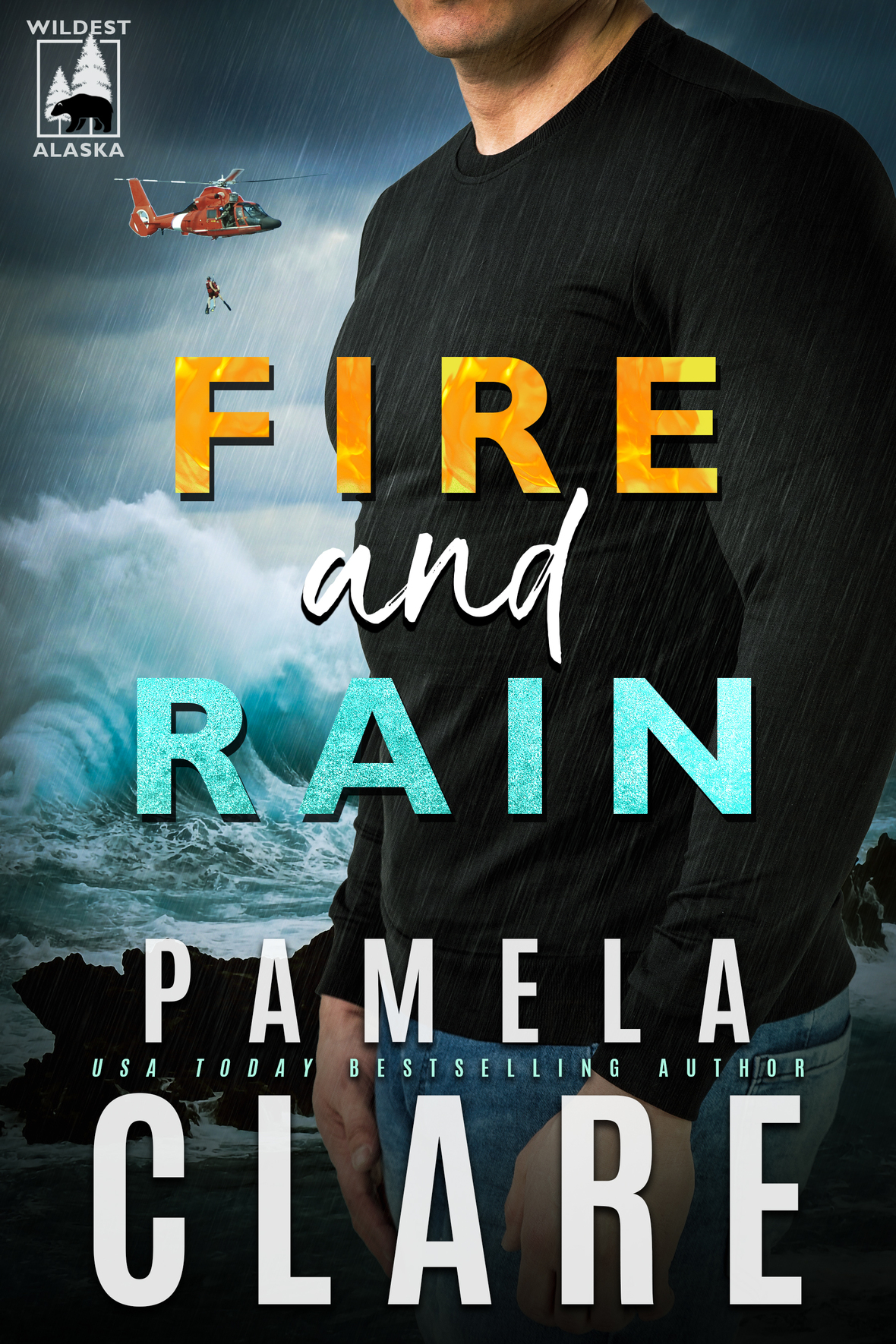
My newsletter readers chose... Chase SanteeCoast Guard Investigative Services Special Agent Chase Santee won last month's poll. He will be the hero of Book 2 in my Wildest Alaska series, titled Snow and Starlight. Chase was last seen getting a medal pinned to his chest for shooting a criminal while hanging out the door of a helo in rough weather. Yes, he's a total badass. So, what can I tell you about the story? I haven't started writing yet for reasons made clear above, but I can tell you this. Anya Alexyev, one of Eden's younger sisters, will be his love match, though neither of them believes that possible at first. She's 24. He's 33. She's a bit of a wild child, while he's into law and order. They find themselves on opposite sides of a criminal investigation. If you're picking up "sexy enemy to lovers" vibes, you're right on. Next month, I'll have a cover reveal for you, as well as a description. Stay tuned! If you haven't yet read Fire and Rain, the first book in the series, it's available for Kindle, Nook, Kobo, and Apple Books. You can also get it through Smashwords/D2D in all ebook formats or in paperback. Don't miss out on Sean and Eden's story. |
|

FIRE AND RAIN is out! Excerpt #2

Fire and Rain (Wildest Alaska, #1) is out in ebook and paperback. You can grab your copy for Kindle, Nook, iBooks, Kobo, or paperback. It's also available on Smashwords in all ebook formats.
I hope you enjoy the first story in this new contemporary adventure series. It's not romantic suspense. It's contemporary romance with a dash of suspense and lots of adventure.
I visited Alaska for 10 days when my older son got married on an Alaskan cruise through the Inside Passage. I could have stayed forever. The bigger-than-life scenery, the fresh air, the cold. I really like the cold. It was breathtaking.
The Coast Guard elements of the story were fascinating for me and completely new. Obviously, Colorado isn't on the coast, so I've never had contact with the Coast Guard. I didn't know that rescue swimmers were considered special operators or that AST A-school (where rescue swimmers train) has a higher drop-on-request rate than the Navy SEALs.
Fire and Rain is my 37th work, my 35th novel, and I'm thrilled that it's out in the world today.
To celebrate the book's release, here's a brief excerpt...
A second excerpt from Fire and Rain — plus a 99 cent sale

As many of you undoubtedly already know, I changed the release date for Fire and Rain to July 26. Summer is a busy time here, and sometimes a book takes longer than you think.
I am loving Sean and Eden and the slow way they transform from friends to lovers. I'm also in love with the setting—Kodiak, AK. Mountains. Ocean. Wildlife. Hot Coast Guardsmen. What's not to love?
The book is available for preorder now for Kindle, Nook, iBooks, and Kobo.
Follow Me


Seduction Game
